



Do it for your patients: Just push the button.

Aim: To investigate whether high-dose HDF offers survival benefits as compared with conventional high-flux HD.
Patients: 1360 patients from 61 dialysis centers in eight European countries, treated with high-flux HD, and deemed to be candidates for a convection volume of at least 23 L per session.
Design: A pragmatic, 1:1 randomized controlled trial with outcomes assessed over 30 months (median). 683 patients were assigned to online high-volume HDF and 677 patients to high-flux HD. High-volume HDF means post-dilution HDF with online production of fluids and convection volume ≥ 23 L per session.
Method: Convection volume targets achieved with stepwise adjustment over 2-3 weeks; interventions and outcomes assessed over 30 months (median)
Primary outcome: Death from any cause.
Secondary outcome: Key secondary outcomes were cause-specific mortality, composite of fatal and nonfatal cardiovascular events, kidney transplantation, and recurrent hospitalizations for any cause and for causes related to infection

The CONVINCE trial demonstrated a survival benefit for patients receiving high-volume hemodiafiltration (HVHDF) compared with high-flux hemodialysis (HD).
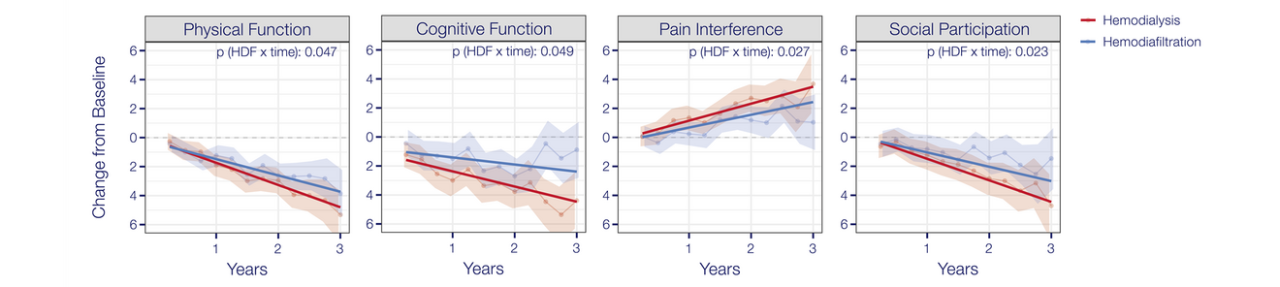
A secondary objective in this randomized controlled trial (RCT) was to evaluate the impact on health-related quality of life (HRQoL).
To assess HRQoL, electronic patient-reported outcome measures from the Patient-Reported Outcome Measurement Information System (PROMIS) were used.
The mean change from baseline after 30 months between HVHDF and HD were assessed for all HRQoL domains.
A linear-mixed model was used to assess HRQoL change from baseline through follow-up time points.
To account for the mortality difference demonstrated in CONVINCE, a post-hoc joint model was conducted to investigate the robustness of the linear-mixed model. The joint model considers the potential dependency of self-reported health status measures and observed differences on mortality rates, thereby reducing the potential bias in the linear-mixed model.
The CONVINCE trial provided a comprehensive and robust evaluation of HRQoL by conducting more frequent and detailed assessments of patient-reported health data than any previous RCTs.
It is the largest nephrology trial that involved patients in developing the questionnaire and using novel electronic PRO measures.
There is no established threshold for PROMIS measures that has been determined to be clinically meaningful to patients with kidney replacement therapy.
The investigated population had an overall lower risk of death than reported in other studies, potentially limiting generalizability of the results.
Significant results (joint model)

Do it for your patients: Just push the button.

2 Blankestijn PJ et al., CONVINCE Scientific Committee Investigators, Effect of Hemodiafiltration or Hemodialysis on Mortality in Kidney Failure, N Engl J Med 2023 Aug 24;389(8):700-709